
RBI Raises Rates Amid Rising Inflation Risks; Stance Shifts to ‘Calibrated Tightening’
#
7th Oct, 2026
- 154 Views


NDNC disclaimer: I hereby authorize Bajaj Life Insurance Limited. to call me on the contact number made available by me on the website with a specific request to call back. I further declare that, irrespective of my contact number being registered on National Customer Preference Register (NCPR) or on National Do Not Call Registry (NDNC), any call made, SMS or WhatsApp sent in response to my request shall not be construed as an Unsolicited Commercial Communication even though the content of the call may be for the purposes of explaining various insurance products and services or solicitation and procurement of insurance business
Mr. Srinivas Rao Ravuri, Chief Investment Officer, Bajaj Life
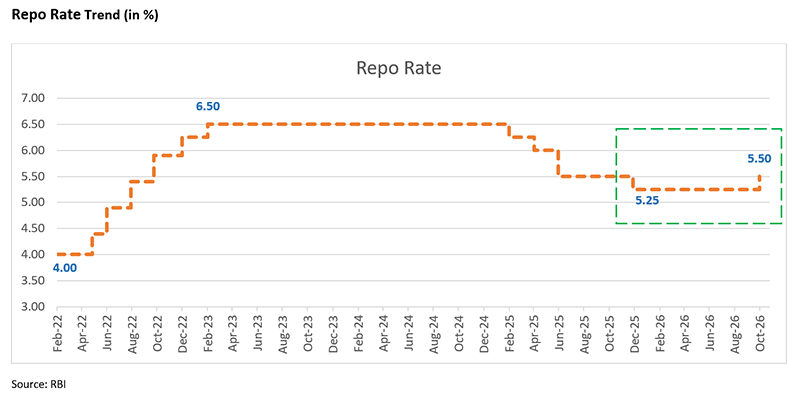
Policy Decision: RBI hikes Repo Rate by 25 bps, Stance changed to ‘calibrated tightening’
The Reserve Bank of India’s Monetary Policy Committee (MPC) unanimously raised the policy repo rate by 25 basis points to 5.50% and shifted its policy stance from ‘neutral’ to ‘calibrated tightening’. The decision comes amid high global public debt (particularly in US), crude oil prices sustaining at elevated levels since the renewed escalations in West Asia, geopolitical uncertainties, and rising inflationary pressures. With domestic growth remaining resilient, the RBI signaled that further policy action will remain data-dependent and guided by the evolving inflation-growth dynamics. We believe that the RBI is likely to undertake a cumulative hike of 50-75 bps in this cycle in the base case.
Growth: Strong Domestic Momentum supports better FY27 outlook
Despite a challenging global environment, India’s economic activity remains resilient. GDP growth in Q1 FY 2026-27 came in at 7.8%, above RBI’s early projection of 7.0%, reflecting a broader momentum across the economy. In Q2 FY 2026-27, available high frequency indicators for July-August suggest sustained momentum in domestic economic activity. Domestic demand remains resilient and is well supported by robust external demand with merchandise exports registering double-digit growth.
Against this backdrop, the RBI has revised its Real GDP growth estimate for FY27 upwards to 7.1%, from 6.7% earlier. Quarterly GDP growth is projected to be 7.2% in Q2, 6.9% in Q3 and 6.8% in Q4. While domestic demand and investment continue to support growth, risks arising from geopolitical tensions, elevated energy prices and droughts remain relevant.
Inflation: Showing Signs of Broadening Price Pressures
Headline CPI inflation accelerated to 4.8% in August 2026 from 4.5% in July, remaining above the RBI’s 4% target for the third consecutive month. Food and fuel prices have been key contributors to this increase, while core inflation has also shown an upward trend, indicating some signs of widening price pressures. The RBI noted that the food price increases have become more broad based and the near-term outlook points towards continued pressures from supply side on account of the deficient monsoon, ongoing El Niño conditions and high energy and other commodity prices, the pass through of which is still continuing.
Consequently, the RBI has raised its FY2026-27 CPI inflation forecast to 5.2%, from 5.0% earlier, with Q2 at 4.9%, Q3 at 6.0% and Q4 at 5.7%. Core inflation is now projected at 4.4% for the year, compared with 4.3% earlier. Inflation for Q1 FY 2027-28 is projected at 5.6 per cent with risks being evenly balanced.
External Sector: Resilience continues despite global challenges
India’s external sector remains resilient despite heightened global uncertainty. While the elevated crude prices will put an upward pressure on Current Account Deficit (CAD) for the remainder of the year, the Balance of Payments (BoP) is expected to record a healthy surplus for the full year, backed by the substantial mobilization of forex deposits through the FCNR(B) scheme. Robust services exports and remittance inflows continue to support the external account.
Capital flows have generally improved, with net FDI inflows rising to US$13.8 billion during the first four months of FY2026-27, compared with US$9.6 billion in the corresponding period last year. However, FPI flows reversed in Sep 2026 after turning positive during Jun-Aug 2026 amidst rising global risk-off sentiment on rising US bond interest rates and re-escalation of Middle East tensions. The RBI continues to monitor global capital flows, exchange-rate movements and commodity prices closely as external conditions remain volatile.
Liquidity & Financial Conditions: Surplus being absorbed through a mix of tools
During August and September, system liquidity increased substantially on account of the recent measures undertaken to attract capital inflows. The RBI will use an appropriate mix of liquidity-management tools to align the weighted average call rate (WACR) with the policy repo rate and strengthen monetary-policy transmission. Credit growth remains robust and broad-based across sectors, while movements in lending and deposit rates indicate that transmission is continuing. The shift towards calibrated tightening, together with active liquidity management, signals a stronger focus on maintaining financial conditions consistent with the inflation objective.
Outlook: RBI moves to an interest rate hiking cycle
The October policy marks a clear change in direction with RBI delivering a 25-bps hike in repo rate to 5.50% along with a change in stance. The overall tone was hawkish, and the ‘calibrated tightening’ stance indicates that there is a possibility of more hikes on account of risks due to high global debt, higher commodity prices, draughts, along with actual inflation and growth data in the coming quarters. The shift reflects the RBI’s assessment that inflation risks have become more persistent and broad-based, even as domestic growth remains strong.
We believe that the RBI is likely to undertake a cumulative hike of 50-75 bps in this cycle in the base case. There is a possibility of more hikes in case of geopolitical tensions worsening and keeping energy prices elevated for a prolonged time. We expect the 10-year G-Sec yield to trade in the 7.20%–7.40% range, while high-quality corporate bonds in the 3–5-year segment continue to offer attractive risk-adjusted return opportunities. The trajectory of global debt, crude oil prices, global trade developments, capital flows and exchange rate movements will remain key variables to watch over the coming quarters.
Annexure:
Repo Rate – The interest rate at which the RBI lends money to commercial banks.
CRR – The share of a bank’s total deposits that must be kept with the RBI in cash.
Stance – It gives an indication to the future policy action.
SDF – The rate at which Banks lend to RBI without collateral.
MSF –The rate at which RBI lends (provides emergency liquidity) to Banks.

Enter your email address to subscribe to this blog and receive notifications of new posts by email.

Facebook
Twitter
pintrest
instagram
Whatsapp
Linkedin
More